
Men’s Health Month Goes Beyond the Gym
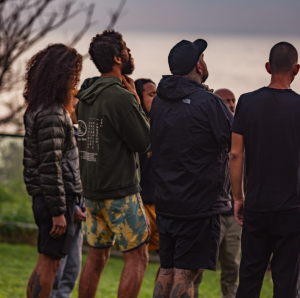 When we hear and talk about men’s health, we so often look to the measurable… the annual physical, the bloodwork and labs, the numbers on a chart, and the reps at the gym. It all factors into the broad conversation of men’s health, of course. But ask the men doing the deep work of tending to their lives and mental health, and a different picture emerges.
A new story is being told around what men’s health really consists of and it’s one that has less to do with what a body can withstand and more to do with what a man is carrying inside. And, importantly, whether he has anyone to help him carry it.
For Men’s Health Month, this November we sat down with Alexandar Lorenz, a licensed massage therapist and movement coach in Keene who co-leads the Keene Men’s Group with Dr. Matthew Allen. The following blog is in large part Alex’s own words because someone actually in the work was the best way we could find to deliver the message.
Connection is a Health Issue
Brotherhood is the Medicine.
A lot of men are carrying a great deal of weight on their shoulders, alone. The script many men grow up reading rewards independence, resilience, and keeping it together. It leaves little room to speak up when something hurts or when emotions are involved. Over time, that isolation can take a toll on relationships, mental health, and the body itself.
We’re made well-aware of the impact of proper nutrition, exercise, getting outdoors, and hydration, but what rarely makes it onto a health checklist is the connection with others.
The work Alex Lorenz is doing with a local men’s circle is a huge part of the answer. It’s not another lecture, achievement, regimen, or “fix” but instead it’s a space men can come to set down the need to pretend. Just for a few hours. And, instead, share with one another the truth of who they are and what they’ve been carrying.
It invites men to step inside and put down the weight and leaves them knowing they don’t have to carry it alone.
What is a Men’s Circle?
Alex explains that while a men’s group can take different forms, “A men’s circle, or men’s group as we call ours, is a group of men who gather regularly with the intention of self-growth and mutual support. They generally involve reflection, honesty, and vulnerability through regular, facilitated meetings. Over time, the group builds trust and becomes a place where men can share parts of themselves that often have very little room in daily life.”
Alex describes the purpose of a men’s group as shedding light on dark places. What one man may carry alone as shame, inadequacy, hurt, or confusion can look very different when it is brought into the light of the group and witnessed by other men.
What sets Alex’s group apart is that it doesn’t stay in the head: “What makes our group unique is that we bring the themes we’re working with into the body.” He and Dr. Allen come from complementary backgrounds, one a chiropractor, the other a massage therapist and movement coach, and they use movement, physical practice, and sometimes play to explore what the group is talking about. “One month we might go to a local martial arts gym to explore confrontation and how we meet conflict in our lives. Another time we might stand in a circle and laugh together, looking at what happens when we permit ourselves to reconnect with something childlike and joyful.”
A place to take off your armor and heal and a place to sharpen your sword.
In the men’s group, they discuss fatherhood, relationships, physical and emotional health, finances, addiction, and grief—the many things that make up a man’s life.
Alex’s Story: Why He Started
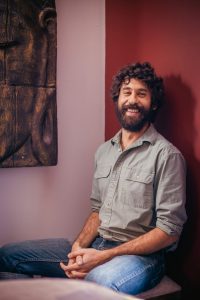 For Alex, this work grew out of personal need long before he recognized the need in others.
“I grew up without much of a father presence or many male role models in my daily life, and much of my early adulthood was spent searching for some of the things a father might have taught me,” he shares. “I found my way through some difficult places, including violence and addiction, and eventually became a father myself. At that point, the question of what it meant to be a man became much more important to me, and I realized I couldn’t figure it all out in isolation.”
He found his way to Sacred Sons, a men’s organization in its early days, and after following their work for years, he attended an in-person gathering that affected him deeply. “I had experienced what was possible when men gathered with honesty and intention, and I wanted to share some of that with the men in my own life.”
He tried a few times to start something smaller, but always knew he couldn’t do it alone. Meeting Dr. Matthew Allen was what made it real.
“At this point, Matthew and I provide the place and the structure, but the group itself is shaped by the men who show up,” he says. “In that sense, the group has become a living thing.”
The Body and the Mind as One
In men’s group, health moves beyond the gym into bringing cohesion to the body and mind. “I believe men’s physical health is intimately connected with our mental, emotional, and relational health,” Alex says, “Although perhaps not always in the way we think about it.”
“We only have to watch a group of young boys playing for an evening to see how much movement, physicality, and play are part of being human. As we grow older, those things can become increasingly restricted. We learn to sit still, to work, to produce, and sometimes to treat rest and play as luxuries rather than necessities.”
His massage and movement work lives this same overlap. “Massage certainly works with muscle and tissue, but it also gives a person an opportunity to experience their body differently. To slow down, pay attention, soften, breathe, or simply notice what is happening without immediately having to fix it. We’re not separate minds walking around inside separate bodies. We’re whole human beings, and our physical, emotional, mental, and relational lives are constantly influencing one another.”
Men need permission to rest just as much as they need encouragement to become stronger. Health isn’t only about how much we can do or how much we can withstand. Sometimes strength means learning when to put the weight down.
“The goal of a healthy mind and body isn’t to abandon strength. It’s to make strength more complete.” – Alex Lorenz
What Happens When Men Stop Carrying It Alone
“There’s a saying in men’s work,” Alex says. “Brotherhood is the medicine.”
“I’ve watched men move to tears and into the depths of emotions they’ve been carrying for years, and then come out the other side lighter. Held. Felt. Real.”
Sometimes the metaphor becomes literal too, “…We literally lift a man up and hold him while he shares something that has weighed on him for years. There is something powerful about taking that metaphor of carrying someone’s burden and making it physical. For a few moments, he doesn’t have to carry it alone. The group carries him.”
While it might be frightening initially, once a man experiences that vulnerability can exist alongside safety, something shifts. Men begin to remember something that was already inside them: lightness, joy, playfulness, the ability to be vulnerable without becoming weak.
If Something Feels Off, But Opening Up Feels Hard
Alex knows what keeps men quiet. “The fear of being misunderstood, the shame we carry from stories that may not even belong to us, or that little voice telling us we’re not worthy of being seen can keep us isolated for a long time.”
“Being brave doesn’t mean telling everything to everyone. The container matters. Opening up to the wrong person can make things harder, not easier. Find someone you trust and start small, tell them one thing that is actually true for you, and let yourself be witnessed without immediately trying to explain it away or fix it. The more we practice bringing what is real into relationship, the easier it can become.”
There are people who want to help you.
Show Up for the Men You Love
For those who want to support a partner, a friend, or a son, Alex’s advice is refreshingly concrete, “One of the most powerful things you can do is make space to listen consistently. Put it on your calendar. Check in every week. Ask questions, and then actually wait for the answers. Pay attention to what makes him smile, what lights him up, what he enjoys, what hurts, and what seems difficult for him to carry.”
“You don’t always need to fix the hurt. Sometimes listening is the thing.”
“Don’t only make space for the difficult things. Make space for joy. Notice what brings that person alive and participate in it with them. That’s one way we help each other become more fully ourselves. By paying attention, by staying connected, and by letting the people we love know that they don’t have to carry everything alone.”
Finding a Men’s Circle Near You
If something in Alex’s words resonated, get involved! There are several men’s circles active right here in the Monadnock region, each with its own flavor. Reaching out to any of them is a brave and ordinary first step.
Keene Men’s Group: Co-led by Alexander Lorenz and Dr. Matthew Allen, this ongoing group meets regularly with its home base in Keene. Matthew and Alex provide the structure, but the group belongs to the men who show up. Anyone curious is welcome to reach out to learn more. There’s no cost or barrier to attending. They do accept suggested donations of $10-25 per meeting for those who are able, and larger events, retreats, and outings do come with a fee. Email: keenemensgroup@gmail.com or find them on Instagram at @keenemensgroup.
Peterborough, NH – Tending Fire: A workshop for young men led by psychologist Paul Frehner of Stillpoint Psychological Services. It runs as seven Wednesday evening gatherings and is geared toward young men (ages 17+) who are shaping a meaningful life. The series draws on Native American teachings and ceremony alongside Buddhist practices of self-awareness. The cost is $300 for the seven weeks, and reduced fees are available, so finances are not meant to be a barrier. An initial conversation is part of joining. To learn more, email Paul at stillpointpsych@pm.me.
A Big Thank You to This Month’s Contributor, Alexander Lorenz of Wild Monk Massage
About Alexander Lorenz
Alexander Lorenz is a licensed massage therapist, movement coach, and owner of Wild Monk Massage & Bodywork in Keene, NH, where he blends anatomical knowledge, hands-on experience, and intuitive listening to help people develop a deeper relationship with their bodies. He also co-leads Keene Men’s Group with Dr. Matthew Allen, creating space for men throughout the Monadnock region to explore connection, vulnerability, health, relationships, and personal growth through conversation, movement, and shared experience. Alexander is also a father and homeschooling parent, and much of his work is informed by his interest in helping build healthier, more connected communities for the next generation.




0 Comments